







 Share
Choosing tiles means evaluating colors, sizes, surfaces, and material effects, but also the way they will be installed. The installation pattern in fact helps define the style of the space, enhance the chosen size, and make the final result more harmonious.
The same tile can take on a different character depending on the layout: more essential with a straight installation, more natural with a staggered installation, more decorative with a herringbone pattern. For this reason, knowing the main tile installation patterns helps to design floors and wall coverings that are more coherent with the home’s style and the desired aesthetic effect.
What are tile installation patterns and what does the choice depend on
Installation patterns indicate how tiles are laid on a surface, whether for floors or walls. They are not a secondary detail, but a very important part of the project: the direction of the grout lines guides the eye through the room, outlines the composition of the spaces, and furnishes the space.
There is no one installation pattern that suits every situation. The choice depends on the tile size, the size of the space, the intended use, and the style you want to achieve.
Before deciding, it’s useful to consider a few aspects: tile size, floor or wall installation, material effect of the surface, width and color of the grout lines, continuity between indoor and outdoor spaces, and any design constraints. A large size requires different considerations than a wood-effect plank; similarly, a bathroom wall covering can be designed with different logic compared to flooring for living rooms or kitchens.
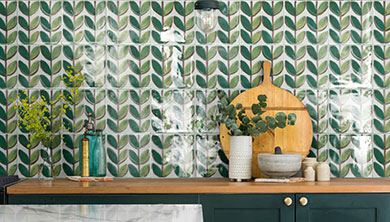
The choice of grout also plays an important role: a tone-on-tone grout makes the surface more uniform, while a contrasting grout highlights the installation pattern more.
The main installation patterns
The most commonly used installation patterns allow for very different results: some are more essential and discreet, others more dynamic or decorative. Let’s take a closer look at their features and how they can influence the perception of the space.
Straight installation
Straight installation is the simplest and most linear pattern, where the tiles are aligned parallel to the walls, creating a regular and orderly grid. It’s a clean, versatile solution suitable for many contexts, ideal when you want to highlight the ceramic surface without introducing a strongly marked installation design.
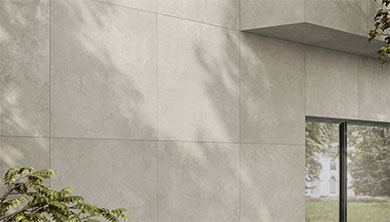
This pattern is particularly recommended for contemporary and minimal spaces, marble-effect, concrete or stone surfaces. Its strength lies in its ability to create a neutral, elegant, and easily coordinated base with furnishings and accessories.


Staggered or running bond installation
Staggered installation, also known as running bond installation, involves laying tiles with joints that are not aligned. The result is more dynamic than straight installation and gives a more natural effect, especially when using rectangular formats.
There are several possibilities: regular staggering creates an orderly composition, running bond installation gives a more spontaneous result, while a subtle stagger adds movement without weighing down the surface.
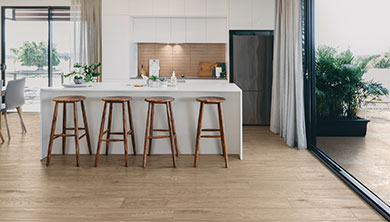
Staggered installation is ideal for wood-effect porcelain stoneware, because it recalls the rhythm of parquet floors. It also works well with stone-effect surfaces, warm and welcoming domestic spaces, hallways, living rooms, bedrooms, and spa-inspired bathrooms.


Herringbone installation pattern
The herringbone tile installation pattern is one of the most decorative solutions. The tiles are arranged to create a rhythmic geometric design, capable of transforming the floor or wall covering into a standout element of the space.
The Italian herringbone features rectangular elements placed at 90°, with a dynamic and recognizable effect. The Hungarian herringbone uses elements cut at an angle, for a more elegant and orderly result; the chevron, instead, creates a continuous zig-zag sequence, with a strongly decorative character.


This pattern is suitable for entrances, living rooms, bedrooms, refined bathrooms, decorative walls, and wood-effect porcelain floors: it’s ideal when you want to add personality to the space while maintaining a balance between naturalness, precision, and style.
Diagonal installation
Diagonal installation lays the tiles at a 45° angle to the walls. This pattern is used to add movement to the surface, especially in rooms with a classic feel or in projects that reinterpret traditional materials.
If used in the right context, it can enhance terracotta, stone, or majolica-effect tiles and make the floor more distinctive. It is suitable for irregularly shaped spaces, entrances, kitchens, bathrooms, and spaces where you want to introduce a more noticeable but still balanced design.
To achieve a harmonious result, it’s important to carefully plan the perimeter cuts and the arrangement of the grout lines. In this case as well, support from a professional helps maintain correct proportions and an orderly final appearance.
How to use modular installation to combine different sizes harmoniously
Modular installation combines tiles of different sizes within the same pattern. It’s a more elaborate solution, designed to create surfaces full of movement and variation.
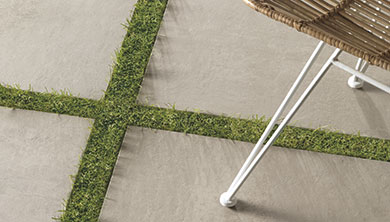
This pattern is ideal for those seeking a less standard floor, with a freer and more tactile composition. It can be used in living areas, kitchens, porches, terraces, and outdoor spaces, especially when aiming for a rustic-contemporary or Mediterranean atmosphere.
However, modular installation requires careful planning: the ratio between the different sizes must be studied in advance, as well as the arrangement of the grout lines and the overall balance of the surface.

Choose surfaces and installation patterns in harmony with Ragno tiles
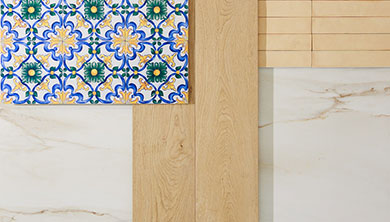
The Ragno collections allow you to interpret different styles through surfaces with wood, stone, concrete, marble, terracotta effects, and decorations. Each material effect can be enhanced by a specific installation pattern: more essential for a contemporary result, more natural for welcoming spaces, more decorative for rooms with a distinctive character.
The installation pattern is therefore not just a technical choice, but a design element. It helps to give rhythm to the surface, to coordinate floors and wall coverings, and to make every room in the home more personal.
There is no one best pattern: the right solution comes from the combination of size, space, aesthetic effect, and desired style. Considering the installation pattern from the earliest stages of the project allows you to make the most of Ragno ceramic and porcelain stoneware tiles, creating beautiful, functional surfaces designed to last over time.